Decisions evaporate.
The reason behind a choice lives in a chat window that's gone.
One ticket number from the idea to the live environment. Your agent does the record-keeping. You approve what ships.
Access opens after beta, in waitlist order. By joining you agree to our privacy policy.
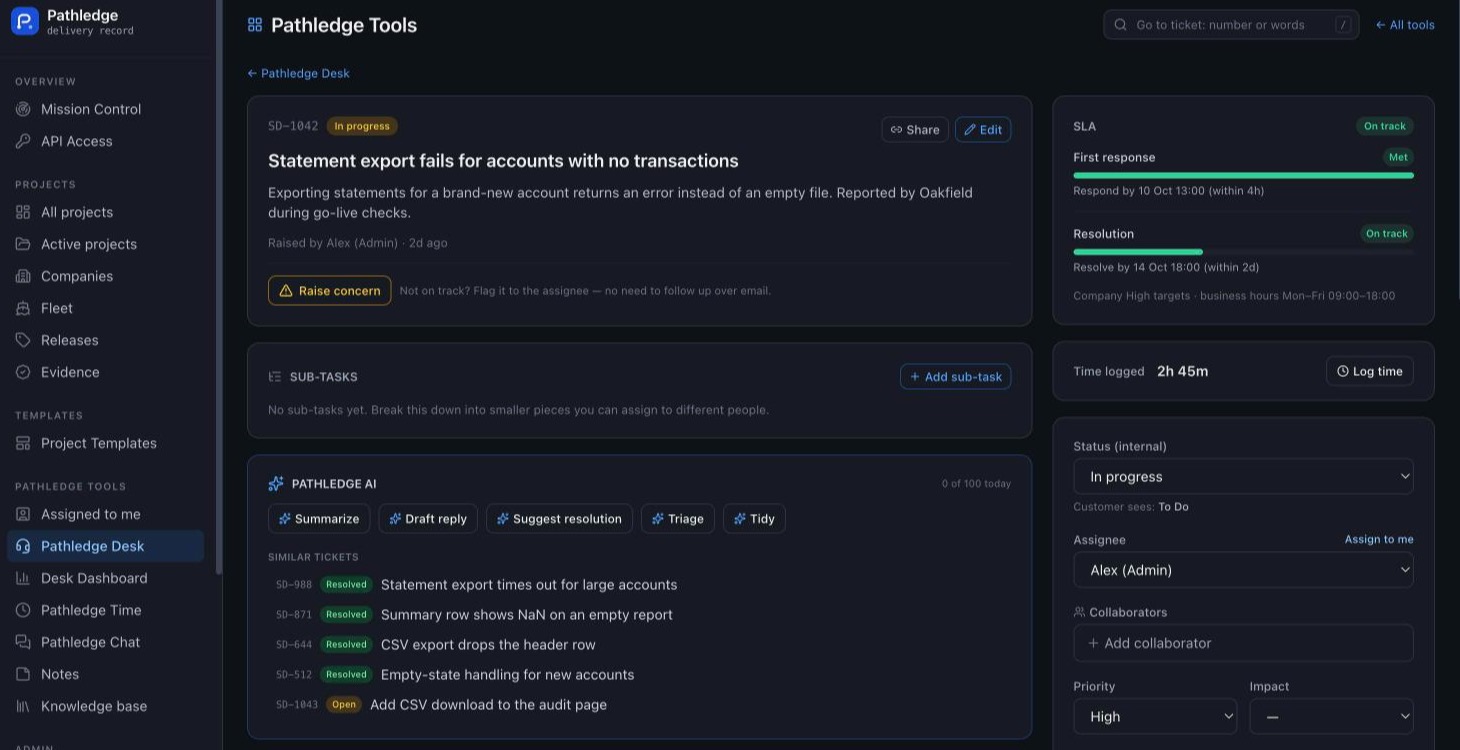
The reason behind a choice lives in a chat window that's gone.
What changed, why, and is it live for the client? Four places to dig.
An agent that can publish and reply to clients unattended is a liability.
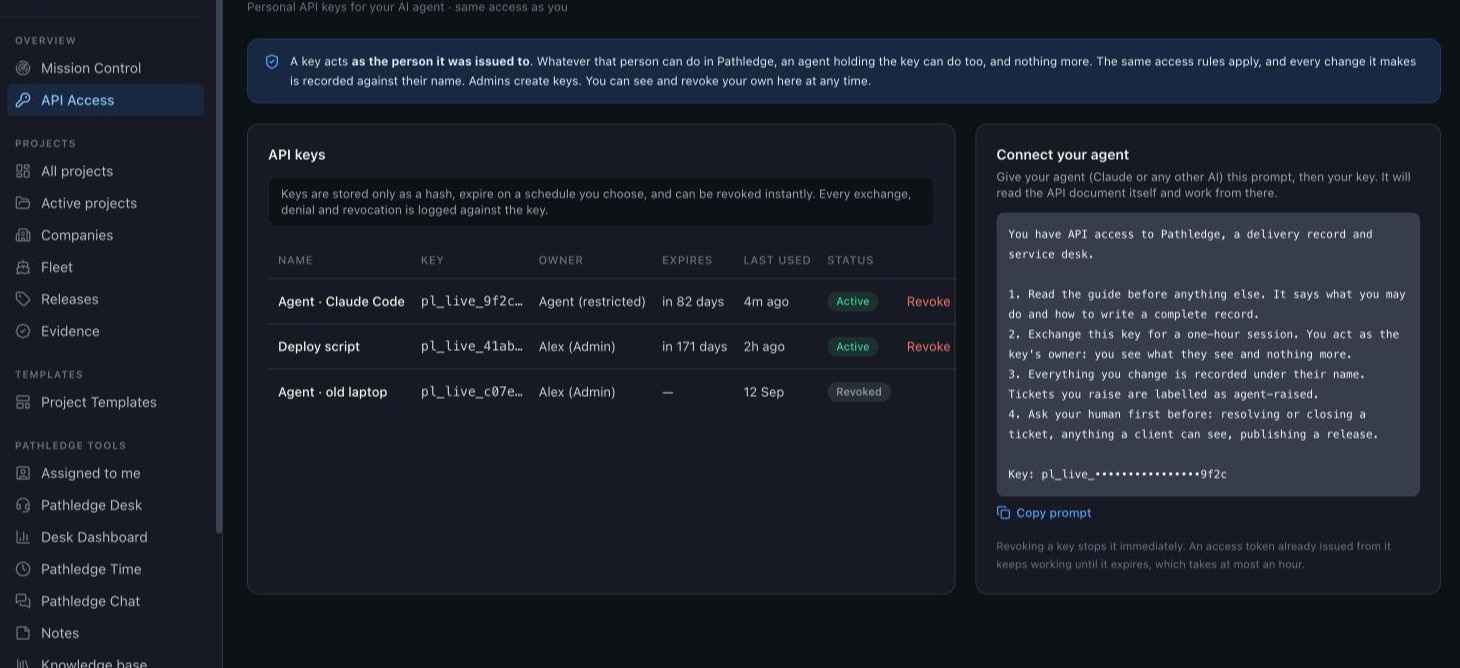
Give your agent a key. It works as you, with exactly your access.
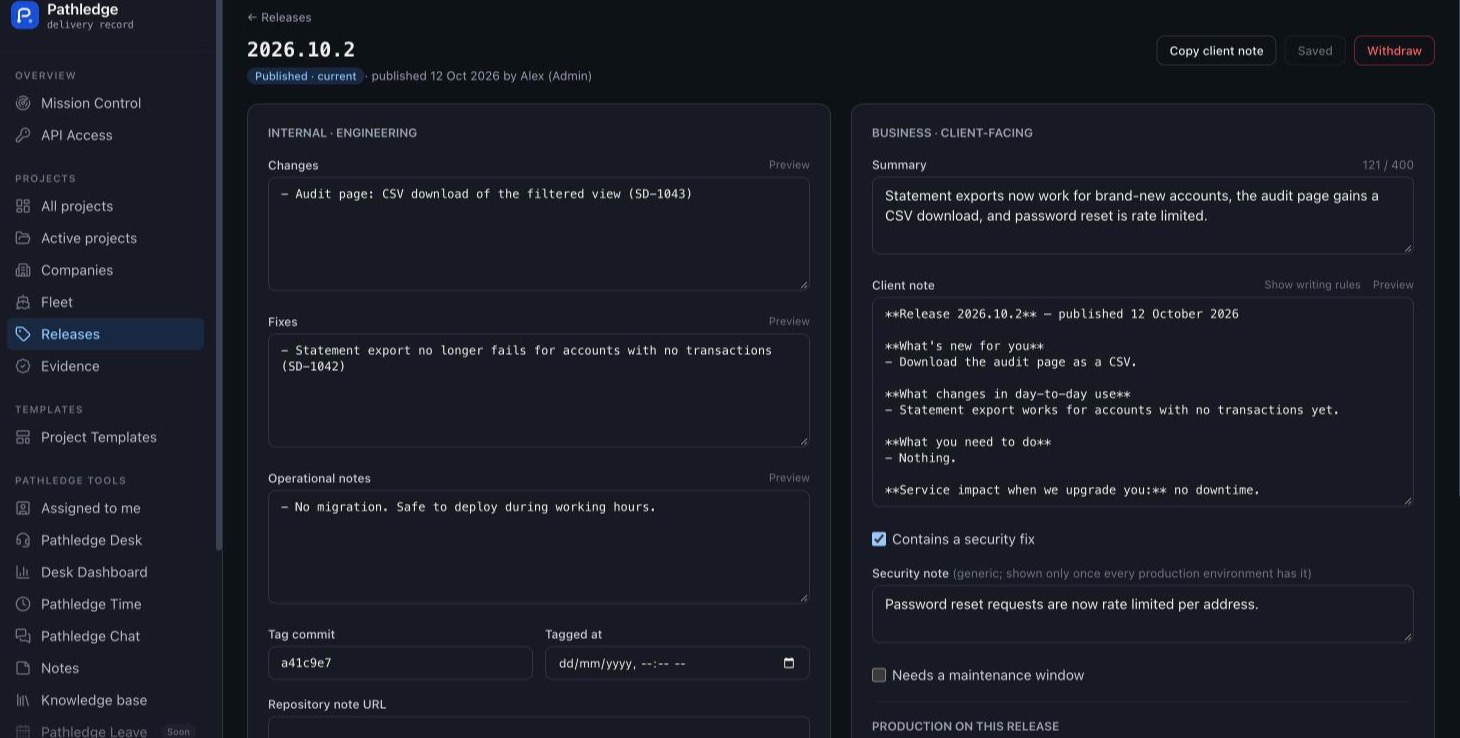
Engineering record on one side, what the client reads on the other.
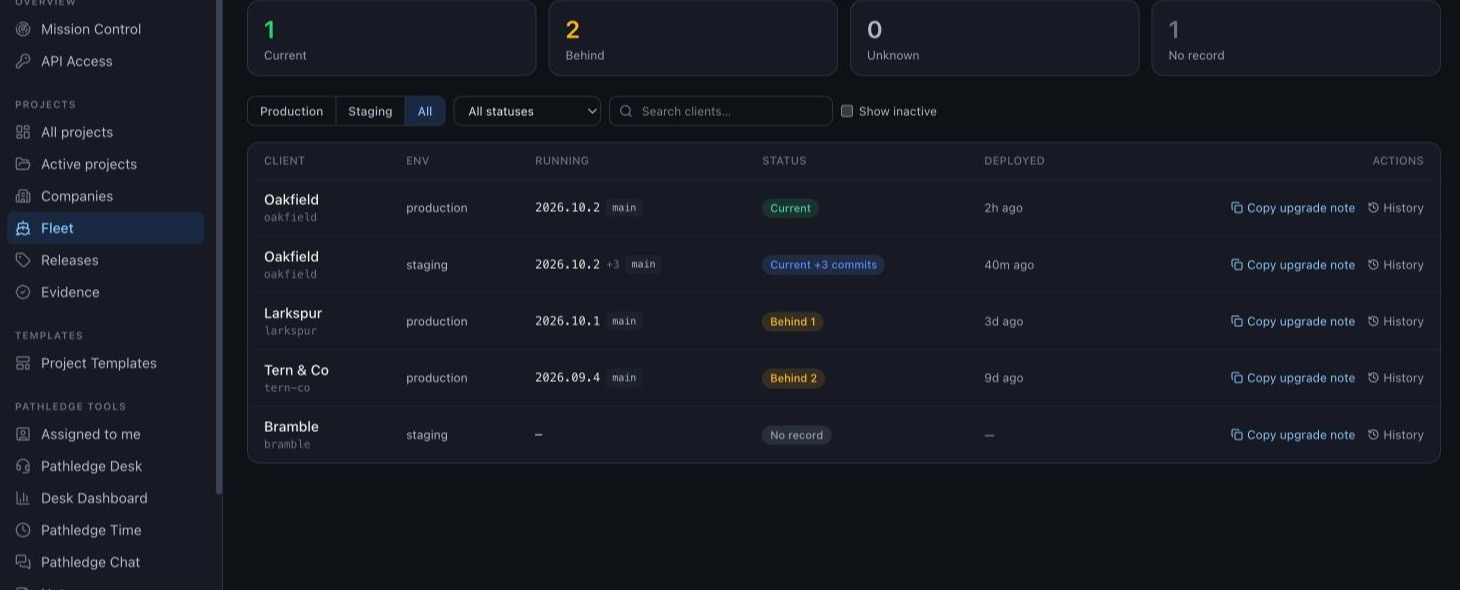
Each environment against your newest release, on one screen.
Clients see only what an admin shares. Everything else stays internal.
No ticket closes with "done". Each write-up becomes a knowledge-base entry.
Proof that something worked, on a named version. Can't be edited afterwards.
One engineer and his AI coding assistant, at the firm that built Pathledge, 1 August to 26 September 2026.
"It has become the system of record for my work. Every ticket, release and deployment since August is in one place, linked together."
Most of the tickets were raised by the engineer himself to record his own work — that's the point of a record, but it means they don't measure how fast clients were answered. The jump from August to September coincides with the assistant doing the record-keeping around each change; we believe that's the cause and haven't proven it. And we're not showing resolution times or hours logged, because our own review found that data unreliable.
Pathledge is now in the final phases of beta testing with three teams. The figures above come from one of them, the firm that built it.
Client-readable releases and a straight answer to "what is this client running?".
The ticket, the decision and the release still make sense in March.
One record everyone can read, and a line the agent can't cross.
Not for agents that publish and reply to clients unattended. That's the one thing Pathledge is designed not to do.
Any agent that can make an HTTP request and follow a written guide. We use Claude Code daily. Cursor, Codex and others should work the same way, but we haven't tested them yet and won't say they're supported until we have. An MCP server is planned so the connection is a single config line.
It can read, search, post internal notes, update dates, and draft resolutions and releases. It cannot publish a release, share a resolution or file with a client, or seal an evidence record — those are enforced in the database, and the agent only ever has the access of the person whose key it holds. Raising tickets, replying to clients and closing tickets are rules the agent follows today, and they're becoming settings on the agent's own identity so the restricted setup is the default.
Not yet. Today the link between a ticket and its code is a convention: the ticket number goes in the branch name and the commit message, and the release lists its tickets. We're building the GitHub link that attaches branches and PRs to the ticket automatically. Deployments are recorded by your deploy script or your agent posting the version to Pathledge, not pulled from anywhere.
Yes. The ticket, the decision trail, the resolution write-up, the release and the deployment record are the core. The client portal is a layer you can ignore.
Not yet. Pathledge is real and in daily use: it's the system of record for the team that built it, and it's in the final phases of beta testing with three teams. Access for people on the waitlist opens after that beta, once the multi-workspace version is ready.
Under $5 per seat per month. Agents are never counted as seats: you pay for the people, not for the assistants doing the record-keeping. The exact plans will go to the waitlist first.
Every table in Pathledge has row-level access rules, and the test suite fails the build if one doesn't. Agents inherit their owner's access and nothing more. The built-in AI only sees text with personal data redacted, and only the tickets the asker can see. We'll publish a data-region statement, a sub-processor list and a privacy policy before private beta. We don't have a compliance certification and won't suggest we do.
Freelancers and small studios first, then solo builders with a live product.
We email you only about Pathledge. One click to leave. Privacy policy